

If you’re shipping AI into production in 2025, you’ve probably asked some version of this question:
“Why would we pay 10x more for a model that’s 5–10x slower?”
On paper, the choice seems obvious: take the fast, cheap model. Sub-second latency, lower bill, easier to justify in a sprint review.
But here’s how that decision often plays out in real teams:
You pick GPT-5-mini for a critical workflow because “it’s 10x cheaper and way faster.” Three weeks later, you’re drowning in error correction, manual reviews, and edge cases the fast model keeps missing.
Meanwhile, another team that chose OpenAI’s GPT-5-Pro — even though it’s 10x more expensive and 5–10x slower per request — ships their production system in half the time. Their advantage isn’t magic. It’s that they understand a simple truth most engineers miss:
In production, the speed that matters isn’t inference latency. It’s time to reliable output.
This isn’t theory. It’s what’s playing out right now across engineering teams navigating 2025’s biggest AI architecture decision.
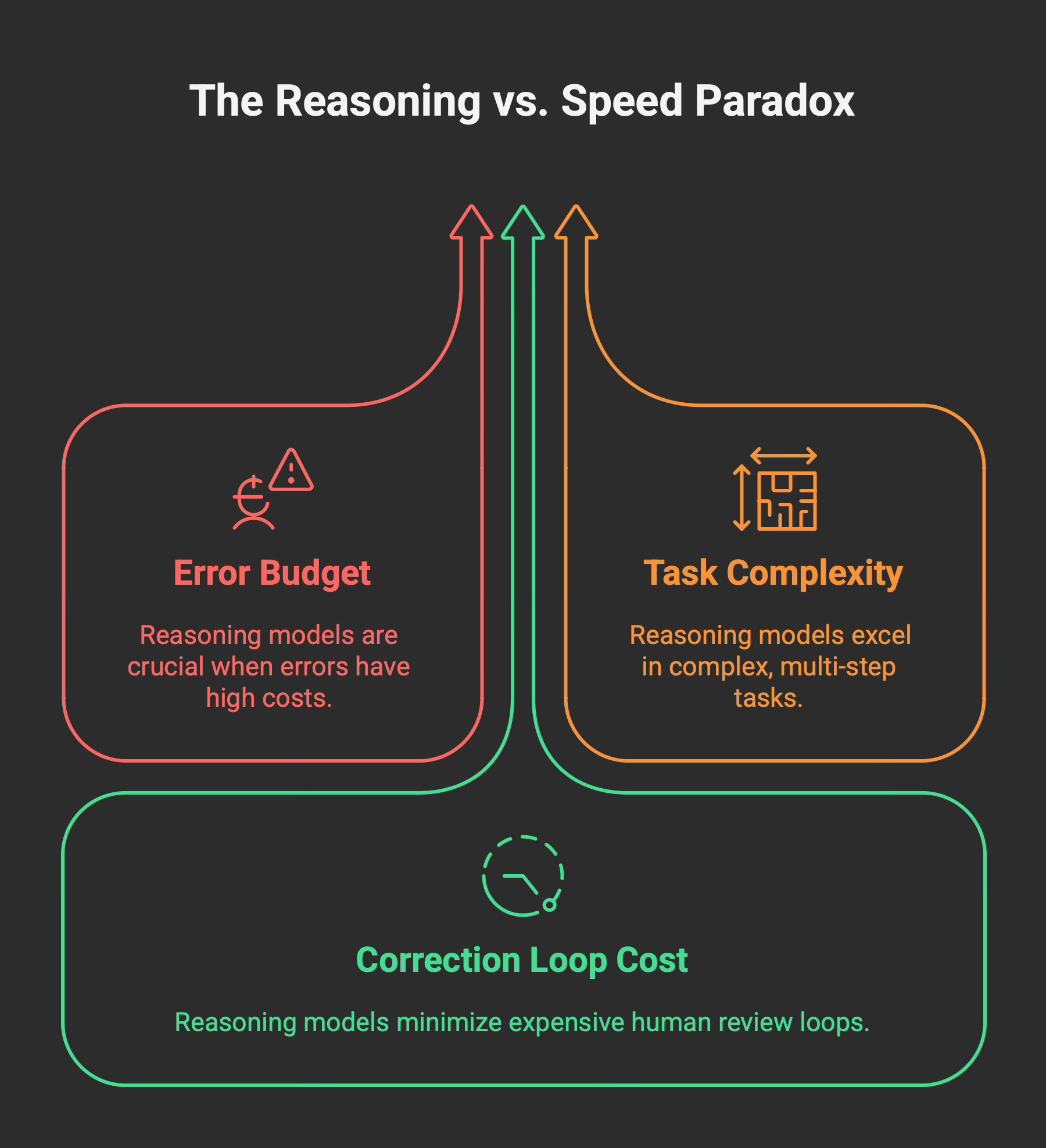
The Two Paths Diverging in Production
Fast Inference Models (GPT-5-mini, Claude Haiku 4.5, Gemini-2.5 Flash):
Sub-second response times
Optimized for throughput and cost
Excel at pattern recognition and straightforward tasks
Cost: $0.15–$2.50 per million input tokens
Reasoning Models (OpenAI 5 Pro, Claude Sonnet/Opus 4.5, Gemini 3 Pro):
5-30 second response times (sometimes minutes for complex tasks)
Use chain-of-thought reasoning before answering
Break problems into logical steps and self-correct
Cost: $15–$120 per million I/O tokens
On paper, fast inference wins every time. 10x cheaper, 10x faster—obvious choice, right?
Wrong.
When “Slow” AI Ships Faster: The Real Numbers
Fast inference models:
Save developers 3.6 hours per week on average
But require significant error correction time
Quality improvements remain “mixed” across implementations
Reasoning models:
Save senior engineers up to 4.4 hours per week
Reduced error rates by 40-75% in complex tasks
Onboarding time cut nearly in half
Microsoft’s data shows reasoning models now generate accurate code in domains where fast models require 3-5 revision cycles. The “slower” model shipped faster because it got it right the first time.
At my startup, we validated this ourselves: Claude 4.5 (Cursor, Thinking, Max Mode) costs us 10x more per request than GPT-5.1-Codex-mini and 4.5x more per request than Haiku-4.5. But it eliminates the back-and-forth that was eating 6-8 hours per week in debugging and refinement.
Total cost of ownership? Lower with reasoning models. Time to production? Faster.
The Framework: 3 Questions That Reveal Your Path
After analyzing production implementations across financial services, healthcare, and our own stealth build, here’s the decision framework that actually works:
Question 1: What’s Your Error Budget?
Use Fast Inference if:
Errors are acceptable or easily recoverable
You have human review already built in
Mistakes don’t cascade or compound
Example: Content recommendations, draft generation, brainstorming
Use Reasoning Models if:
Errors have regulatory, financial, or safety consequences
Manual correction costs exceed compute costs
Mistakes create downstream technical debt
Example: Financial compliance, medical diagnostics, code review for production systems, legal document analysis
Question 2: Is This Multi-Step Logic or Pattern Matching?
Use Fast Inference if:
Task is single-step or straightforward classification
Historical patterns strongly predict outcomes
Speed/throughput is the primary KPI
Example: Image classification, sentiment analysis, simple Q&A, data extraction
Use Reasoning Models if:
Task requires breaking down a problem into logical steps
Context and nuance change the answer significantly
You need explainable decisions (for compliance or debugging)
Example: Complex code refactoring, multi-constraint optimization, debugging distributed systems, strategic planning
Question 3: What’s the Correction Loop Cost?
Use Fast Inference if:
Correction is automated or cheap
High volume justifies some failures
Output is intermediate, not final
Example: First-pass code suggestions, search result ranking, A/B test generation
Use Reasoning Models if:
Human review is expensive (engineering time, specialist time)
Each error triggers manual investigation
Failures block deployment or require rollback
Example: Database migration scripts, infrastructure-as-code, security patches, customer-facing automation
The Hybrid Architecture Pattern
The teams shipping fastest in November 2025 aren’t choosing one or the other. They’re architecting hybrid systems:
Layer 1 (Fast Inference):
Initial screening and routing
High-volume, low-risk decisions
User-facing responsiveness
Layer 2 (Reasoning Models):
Complex cases escalated from Layer 1
Final validation before critical actions
Tasks where explanation is required
The Implementation Checklist
Before you choose, measure these in your specific context:
For Fast Inference:
Run 100 production-like test cases
Measure: accuracy, edge case handling, consistency
Calculate: error correction time × error rate
If (correction cost) < (reasoning premium), use fast inference
For Reasoning Models:
Test on your 10 hardest production cases
Measure: first-pass accuracy, explanation quality, self-correction
Calculate: (avoided errors × correction cost) - (reasoning premium)
If positive, reasoning justifies the cost
Hybrid System Design:
Categorize your workflows by complexity and stakes
Route simple/low-risk → fast inference
Route complex/high-risk → reasoning models
Monitor and adjust routing rules based on real accuracy data
The pattern is clear: Fast inference for volume, reasoning for value.
The Counterintuitive Truth
At Microsoft, we learned that scale isn’t about doing more faster—it’s about doing the right things reliably. The same lesson applies to AI model selection.
Slow reasoning models often ship faster than fast inference models. Not in spite of being slower, but because they eliminate the iteration tax.
Your $50K decision isn’t really about reasoning vs. speed. It’s about understanding what “fast” actually means in production.
Sometimes, the fastest path to done is taking a few extra seconds to think.
Building with reasoning models in production? Hit reply and tell me—what’s the hardest part of the speed vs. accuracy trade-off in your domain? I read and respond to every reply.
If this framework helped you think differently about your AI architecture, forward it to your tech lead. They’re probably making this decision right now.
– Ishmeet.
I’m documenting my journey building agentic systems in stealth. Connect with me on LinkedIn for real-time updates and lessons learned.